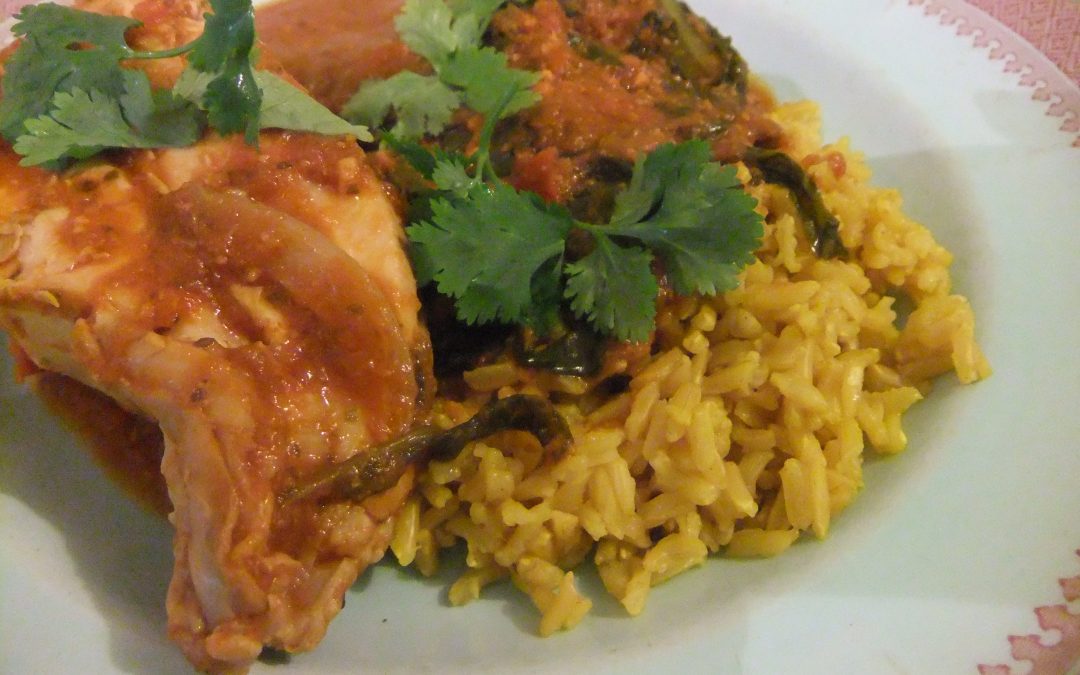
I ate this yesterday and enjoyed every bite. For a change I made it using chicken pieces on the bone (instead of bite size chicken pieces) and so then I cooked it for longer. The sauce of tomatoes, chillies, coriander, garlic and ginger also makes a brilliant cook-in sauce for vegetables, white fish, tofu, pre-cooked lamb, or cooked chickpeas. It also freezes well for future fast dinners.
For 2 people Remember to check out my “larder & shopping” section for unusual ingredients
25g creamed coconut cut up roughly OR ½ cup of thick full-fat tinned coconut milk
3-4cm approx of fresh ginger root, peeled
500g (500ml) bottle of passata (sieved tomatoes – from all supermarkets)
2 green chillies or ¼ teaspoon chilli powder (optional)
1 large handful fresh coriander if you have it
2 large garlic cloves
2 skinless chicken fillets, ideally organic, cut into bite sized chunks
300g organic baby leaf spinach* or chard
Brown basmati rice (optional) plus ground turmeric for cooking.
Version 1 (made with food processor or liquidiser)
1. Peel the garlic, de-seed the chillies (or if you like your dish quite hot leave them in), chop the ginger and coriander roughly and throw the lot into a small food processor. A food processor is preferable to jug liquidiser as if gets the ingredients ground up more quickly.
2. Add enough of the passata to get everything going and blitz until smooth.
3. Pour into a saucepan, add the rest of the passata and the creamed coconut or coconut milk and simmer for a few minutes till the coconut is melted. Stir.
4. Add the chicken pieces and simmer till tender (about 10 mins)
5. Stir in the spinach, turn up the heat and cook until wilted (about 5 mins)
Version 2 (without kitchen gadgets)
1. De-seed and chop the chillies, crush or finely chop the garlic, chop up the creamed coconut and the coriander roughly, finely grate the ginger.
2. Put all of this, with the passata, into a saucepan
3. Simmer for a few mins until the creamed coconut melts, stirring occasionally.
4. Add chicken and simmer until tender (about 10 mins)
5. Stir in the spinach, turn up the heat and cook until wilted (about 5 mins).
*Conventional spinach is one of the most agri-chemical contaminated vegetables you can buy. If you cant get organic spinach then using chard, sliced green leeks, or steamed-til-tender broccoli or steamed green beans are good substitutions.
Serve with:
Some steamed broccoli florets.
If you are not wanting to lose weight and are not on a ketogenic or stoneage/paleo diet you could add (for 2 people):
Brown basmati rice (*boil ½ mug brown rice with 1 mug boiling water and ½ teaspoon ground turmeric, covered, till water is absorbed and rice is fluffed up).
Variation: If you prefer to leave your chicken fillets whole, simply cook for longer in the sauce (about 25 minutes) until cooked through, before adding the spinach for the last few minutes.
Why this recipe is good for you: Processed tomatoes with no additives are a rich source of lycopene, an antioxidant that protects your skin from the damaging effects UV rays – like an edible sunblock! Your body absorbs lycopene better from pureed tomatoes than from whole tomatoes. Ginger, tomatoes, turmeric and chillies all have anti-inflammatory properties that are helpful for a healthy digestive system and good, clear skin. Non organic rice can be heavily contaminated with arsenic but fresh coriander bind to this and other toxic metals in your intestines, helping them be eliminated from your body. Spices like ginger help boost liver function, also to eliminate both natural and man-made toxins. Yet more reasons why herbs and spices are fantastic for you. Using passata packaged in glass jars or bottles means less exposure to toxic bisphenol A (BPA) , which is present in the plastic linings of cartons and tins. Scientific studies link BPA to hormonal imbalances such as low libido, endometriosis, fibroids, and hormone (e.g. breast and prostate cancer) as well as osteoporosis. Limiting your exposure is good news.
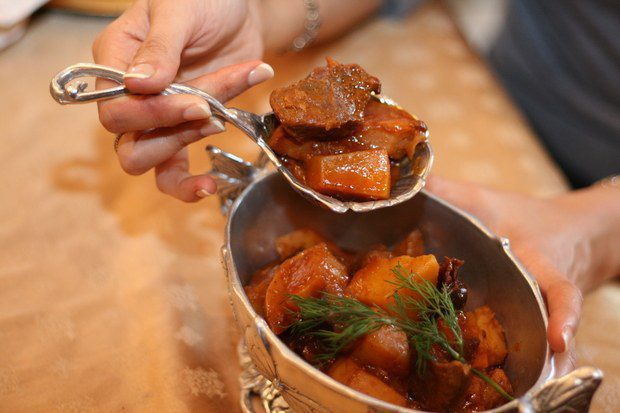
This is another lovely slow-cook recipe for winter. You could also do it on top of the stove so it simmers gently after initially coming up to the boil.
For 2:
250g lamb gigot chops (with bones) or fillet, trimmed of fat and sliced (with bones is better for the flavour)
220g onions (ideally a massive Spanish onion as it saves peeling time!)
2 medium potatoes, ideally a floury type, scrubbed and sliced into rings
1 medium quince/tart eating apple (eg cox’s pippin) washed, and sliced into thick rings (no need to core or peel)
6 large prunes, soaked overnight, drained, stoned and chopped (or use no-soak prunes)
1 level tsp turmeric
2 heaped tsp tomato puree
Juice of 1 small lemon, or to taste
Preheat the oven to 180C
Put a few pieces of the meat in an ovenproof casserole and cover with layers of onion, potato, quince, prunes and spices. Repeat the layers until all the ingredients are used up.
Dissolve tomato puree in 120ml cold water or leftover veg cooking water, then pour into the casserole.
Cover and cook in the oven until the meat and potatoes are tender. This takes 2 hours if using lamb gigot/fillet. If using unsoaked prunes double the quantity of water in the dish and check every ½ hour to ensure it does not dry out and burn (I found this out by experience!).
Hand around the lemon juice at the table to be added to taste.
Serve with one of these:
A large green salad
Steamed frozen peas
Steamed broccoli or (even better) purple sprouting broccoli
Baby spinach leaves and halved cherry tomatoes drizzled with virgin olive oil
Variations:
Use trimmed organic sirloin steak (takes about an hour but be aware quince takes much longer to cook than an hour so use the apple with this instead) or round steak (takes about 2 hours) instead of the lamb.
Why this recipe is good for you: Powerful antioxidants for health come from the tomato puree (lycopene) and turmeric (curcumin) in this dish. Onions, quince and apples are a great source of soluble fibre to feed beneficial gut bacteria. Meat cooked on the bone releases collageneous substances into the liquid that help nourish and heal the lining of your digestive system. Yes, home made chicken soup and other bone-based broth soups really are good for you. Lamb is a more natural meat exposed to fewer intensive farming practices than some other meats so if you can’t buy organic read meat, its a good choice.
I knew I would be in a hurry the other morning with an early clinic so I threw together the ingredients for this deliciously thick smoothie the night before and blitzed them in the morning. If you like your smoothie thinner, add more liquid. If you prefer it thicker add less liquid and eat from the glass with a spoon like I do – yum!
For 1 hungry adult:
Remember to consult my “larder & shopping” section for unusual ingredients
2 rounded dsp high quality unsweetened protein powder of your choice – e.g. sprouted rice protein, hemp protein, Sun Warrior protein powder (or for a dairy option try Solgar Whey-to-Go Vanilla)
200ml unsweetened additive-free milk of your choice: almond, hemp, coconut milk, milk or (if you can eat gluten) oatmilk
1 ripe organic pear, washed
1 heaped tsp cocoa powder, organic if possible
1 heaped tbs flax or chia seeds, ideally soaked in water overnight
Optional: A pinch of pure stevia powder or a few drops of stevia drops to sweeten
1. Cut the flesh off the pear (no need to peel) and throw in the liquidiser.
2. Add all the other ingredients. Blitz for a minute until smoothish. Enjoy.
Variation:
Pear and ginger smoothie: drop the chocolate and substitute 1 dsp grated fresh ginger root (peeled before grating).
Why this smoothie is better for you: It’s almost always best to chew your food rather than grinding it up and drinking it. This is because food you have to chew stays in your stomach longer and makes you feel fuller longer too. Chewing your food mixes it with your saliva, starting the digestive process (with the enzyme salivary amylase) in the mouth so “chewing” this smoothie rather than gulping it down helps digestion enormously. Soaking nuts and seeds overnight starts the process of sprouting them, making their nutrients more digestible. Chia and flax, when ground, are a rich source of omega 3 fatty acids and minerals. Protein is an essential component of a good breakfast, helping regulate blood sugar to keep energy levels and mood even through the morning. Avocados are rich in monounsaturated fatty acids and vitamin E, great for moisturising skin and body fromwithin. Yoghurt and keffir provide friendly bacteria important for a healthy digestion, clear skin and stable mood. Fermenting makes the soya or dairy milk easily digested. Lecithin granules help emulsify (digest) fats and are a great source of phospatidyl choline. Phos choline is only found in egg yolks, lecithin and organ meats. Chlorella and spirulina are seaweeds so are rich in iodine. Iodine is needed for the body to effectively eliminate oestrogen (oestradiol), which in excess causes breast and other hormone-driven cancers. Fluoride, chlorine and wheat flour products suppress iodine utilisation in the body.
Wholegrain millet is an earthy tasting fluffy grain when cooked. It’s really cheap and is great for mopping up sauces/juices. Its a far healthier choice than couscous but looks really similar when cooked. Make sure to buy millet wholegrains instead of the flakes (which will become porridge!). Millet is naturally gluten-free and high in nutrients whereas couscous is made from white flour, low in nutrients.
Enough to feed 3 people as an accompaniment (NOT suitable for SC diet)
Put your millet into a small saucepan. Add the boiling water and cook, covered, for 8-10 mins. No need to stir.
The grains are done when you can see little steam holes in the surface, the water will be absorbed and it looks fluffy like couscous. Make sure you don’t put the millet in cold water or cook for too long or the result won’t be nice.
Variation:
After cooking, drizzle a little extra virgin olive oil on top of the millet, and sprinkle over some ground paprika. This looks lovely in a serving bowl. You could also sprinkle on some fresh coriander leaves.
Why this is good for you: Millet grains are a rich source of magnesium and also of vitamin B17. Magnesium helps clear toxins from the body and also aids relaxation, helping you stay chilled under pressure. Its also great value. Vitamin B17 is a powerful nutrientwith action against cancer cells. Vitamin B17 is also found in many bitter tasting seeds such as those of apples, pears as well as bitter apricot kernals. Millet is an alkaline grain, which helps support bone density, joint health and vitality generally. An alkaline food is one that after the body has “burned” it for energy, leaves an alkaline residue. Fruits, vegetables, beans, pulses, millet, buckwheat and apple cider vinegar are alkaline whereas cheese, milk, wheat, meat, fish, and eggs are acidic. Acidic foods, when not balanced by alkaline ones, can cause skin, digestive, bone, joint, kidney and heart problems. Eating about 80% of your diet as alkaline foods is associated with a longer healthy lifespan.
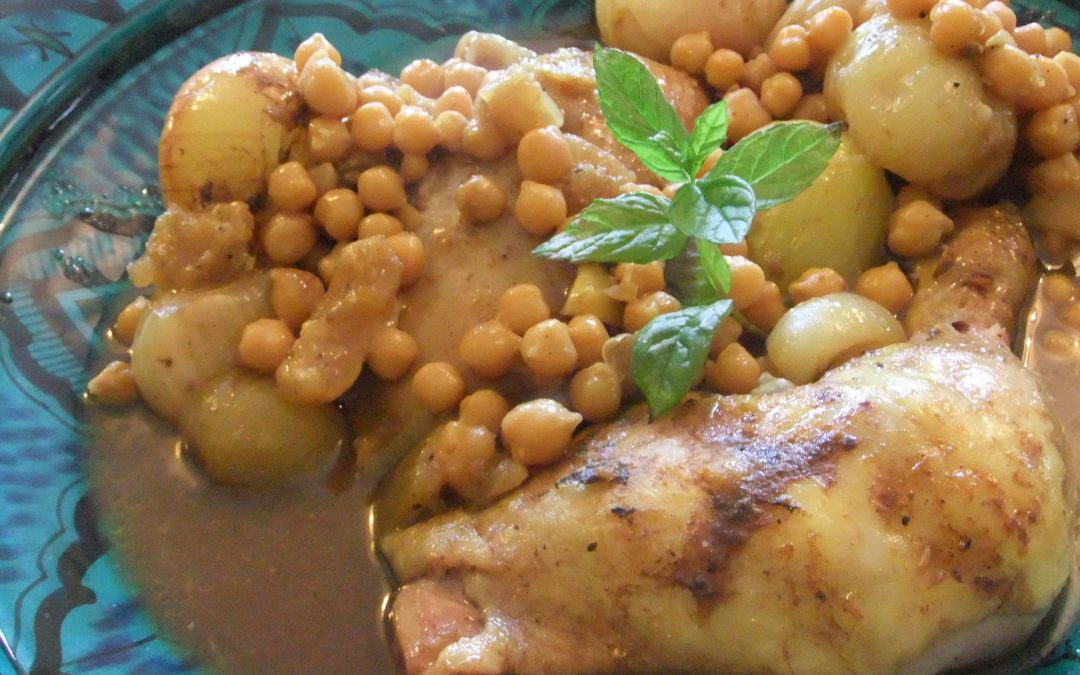
Now the autumn chills are setting in this is a lovely slow-cooked recipe to warm you up. It’s richly-flavoured but really mild. It’s ideal if you are cooking one meal to please meat eaters and people who want to eat less meat at the same time. People can avoid the meat part of the dish and bulk up on extra chickpeas and vegetables and have some delicious fluffy cooked millet grains on the side. Using meat on the bone makes this really flavourful. I usually serve this with some sort of steamed green vegetable (like green beans or dark green cabbage) or a green salad. To stretch things out a bit and save money adding cooked millet to soak up the juices is a winner. If you are new to super-nutritious and super-inexpensive millet, check out my post on how to cook ithttps://annacollins.ie/how-to-cook-millet-i-cant-believe-its-not-couscous/
For 2:
2 mugs (around 450ml) of leftover veg or chickpea cooking water, or plain filtered water
300g small onions or large shallots (large onions will do if you cant get small ones)
1 mug home-cooked chickpeas (reserve the liquid) or a 400g can of chickpeas
2 large cloves garlic, peeled and roughly quartered or sliced
½ a medium size preserved lemon*, deseeded and roughly cut up into 8 pieces – at a pinch you could use ½ a fresh lemon (skin and pith only). Buy ready-made, or use the easy recipe below and leave to mature for at least 2 weeks before using.
2 chicken breasts on the bone or chicken legs (organic if possible)
1 heaped teaspoon ras el hanout*(see simple recipe below, or buy ready-made) For unusual ingredients see “larder & shopping” section of this blog
1. Put a heavy bottomed saucepan or cast iron pot on a medium heat to warm with the 2 mugfuls of stock or water. Put the chicken legs or breasts at the bottom of the pot. Peel and add the onions, ras al hanout, chickpeas, preserved lemon and garlic. Put the lid on, give everything a gentle shake to mix everything up. You want the water to almost cover everything.
2. Simmer gently for 1½ to 2 hours (stirring occasionally to coat everything in the liquid and spices) until the onions are translucent and the chicken is falling off the bone.
Money-saving health-boosting tip:
Serve this with cooked millet. Cooked millet wholegrains are a healthy replacement for couscous, but very similar in appearance and texture. For instructions on how to cook, click the “grains” section in the tag cloud on the left of this blog, or search for “how to cook millet” in the search box.
How to make ras el hanout
Traditionally, ras el hanout contained a blend of 40 different spices. This streamlined version includes many of the main spices of the traditional mixture. Keep this mix in an airtight glass jar in a dark place to preserve the aromas for many months. If you like this spice mix, you will use it again and again as tagine stews are really simple to make. If you own a coffee or spice grinder, you can grind your own spices for extra flavour. Ras al hanout
Makes ½ a medium size jar of ras el hanout:
2 teaspoon ground cumin
2 teaspoon ground ginger
3 teaspoon turmeric
1½ teaspoon ground cinnamon
1½ teaspoon freshly ground black pepper
1 teaspoon ground white pepper
1 teaspoon ground coriander seeds
1 teaspoon cayenne
1 teaspoon ground allspice
1 teaspoon ground nutmeg
½ teaspoon ground cloves
Instructions: Mix spices together. Store airtight in a dark place to preserve the potency of the spices.
How to make preserved Lemons
These have a distinctive flavour its hard to replicate. These are easily made if you cant find a local Halal shop near you or don’t live near Fallon & Byrne. They take at least 2 weeks before they are ready and will keep for a year. I usually keep mine in the fridge but its not absolutely necessary. These take about 2 weeks to mature.
A carton of Atlantic sea salt or Himalayan (pink) salt
10 unwaxed lemons, organic if possible, scrubbed well
A large glass jar with lid
1. Standing a lemon on one end make a cut down the centre with a sharp knife until you have cut 2/3 of the way down.
2. Now turn the lemon upside down and rotate it 90 degrees. Make another cut at right angles to the original cut, also 2/3 of the way down the fruit.
3. Pack the slits with salt and place in the jar. Continue until the lemons are all packed tightly in the jar.
4. Over the next week or two you will see liquid coming out of the lemons. This is normal. When using a lemon for cooking you will need to discard the seeds and rinse off the salty liquid. After 2 weeks the lemons are ready to use.
Why this is good for you: Spices in the ras al hanout are a fantastic source of antioxidants to help your health. Spices help reduce inflammation in the digestive system. Research shows that spices also boost liver function and help keep your skin clear and young-looking. Traditionally, Moroccan dishes are cooked on a low flame for a long time. Modern, cheffy recipes telling you to brown the meat are neither as authentic nor as healthy as the traditional ways. Cooking foods at low temperature (stewing) rather than at high temperature (frying, roasting or grilling) is better because low temperatures produce far fewer damaging free radicals than high temperature cooking. Fewer free radicals and more antioxidants from the spices means slowing down the ageing process, reducing the risk of chronic or life-threatening disease, and helping your heart. Stewing meat on the bone releases substances into the food that help support collagen production. This helps your digestive system repair itself and also helps maintain good firm skin and bones in later life.