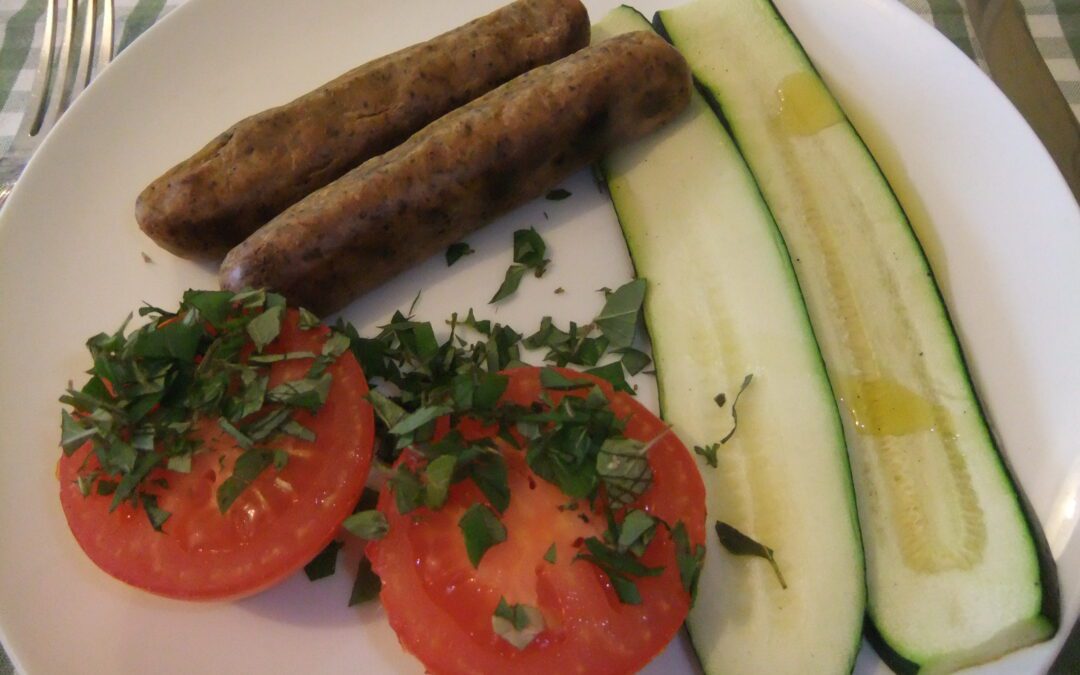
This was one of my favorite breakfasts on a weekday when I didn’t have that much time and I didn’t have to be gluten-free. Now that I know I’m coeliac I use the gluten-free alternatives mentioned below. Cooking in the oven makes it handy, because (unlike grilling) you don’t have to watch it every minute. These Taifun brand sausages are vegan and contain 11% protein so are great for keeping you satisfied for longer. Check out my “larder” on the menu for where to buy these and other unusual foods. Make sure you get the “grill herb sausages” though, they are the nicest. These sausages are not gluten-free as they contain soya sauce and small amounts of oats (which can be contaminated with gluten grains). For the gluten-free option, see the Taifun Basil Tofu option below in the recipe. You could also eat this for a light lunch or dinner. All the Taifun products keep for ages in the fridge.
For 1 person:
1 tomato
1 medium courgette
2 Taifun grill herb sausages (these contain gluten, for gluten-free- slice 1/2 a block of Taifun Basil Tofu or Tofu Rosso into 3 thick slices instead)
Extra virgin olive oil
1 tsp dried oregano or 1 tbsp chopped fresh oregano
Freshly ground black pepper
Put the sausages on a baking sheet in the oven and switch on to 170C (or 150C in a fan oven). Wash the courgette and tomato. Halve the tomato and slice the courgette lengthways – sliced 1/2-2/3 cm thick is just about right, I think.
Leave the sausages to cook in the heating-up oven for around 25-30 minutes while you shower or generally get ready for the day.
After 25 mins remove the baking sheet from the oven. The sausages or basil tofu should be swollen up and slightly coloured now. Add the courgette slices and tomato halves and pop into the oven for another 5 minutes. This way the veggies will be hot but not mushy. They will retain lots of nutrients this way.
Arrange everything on a plate, drizzle a teaspoon of olive oil over the courgette slices, sprinkle the oregano over the tomatoes, and add a few good grinds of black pepper. Why this recipe is good for you: The oregano and tomatoes in this recipe are packed with antioxidants that help your health – by lowering inflammation, delaying ageing, and (in the case of oregano) inhibiting the growth of pathogenic (“bad”) organisms in the gut. Research suggests that unfermented soya products (eg soya milk, textured soya vegetable protein) are not likely to be helpful to health whereas traditional products that are fermented (fermented tofu, tempeh, miso, natto) have lots of evidence to support usefulness in adult hormonal health, especially in relation to breasts and prostate. Fermented soya products are an excellent source of high-quality protein to keep you feeling fuller for longer. If you have autoimmune conditions though, you may need to avoid soya products.
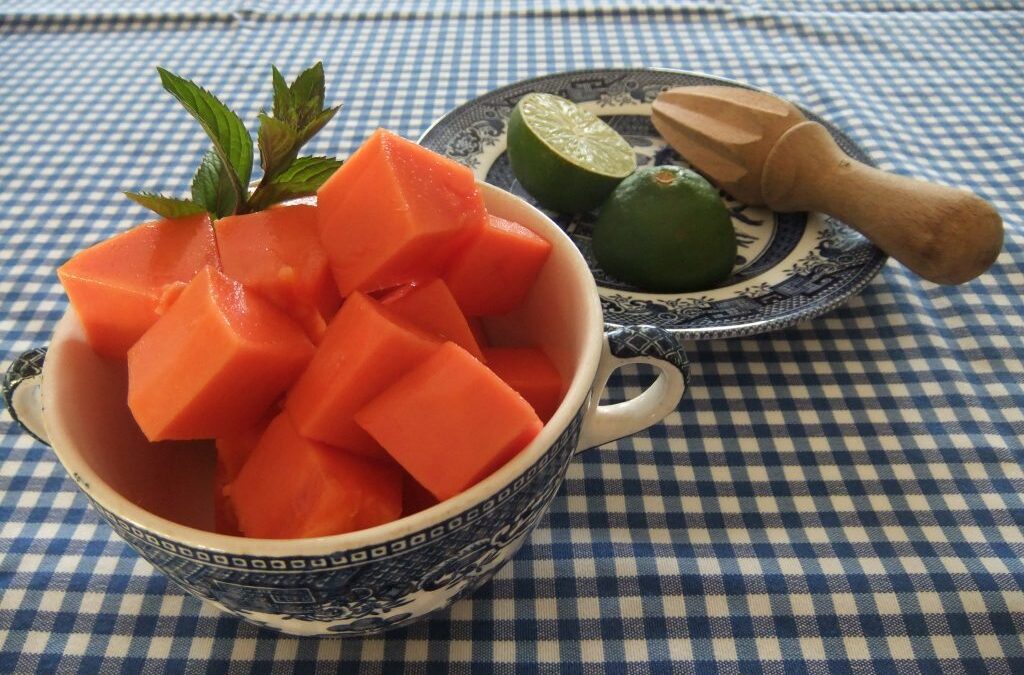
Last weekend I craved some fresh, gorgeous, ripe papaya so we visited the Asia Market in Dublin 2 where we picked up an enormous specimen for about €7. We cut about a third off, scooped out the spherical black seeds, peeled the section with a potato peeler, and cubed it before piling it into bowls and drizzling with lime juice. The rest we kept in the fridge for the next day, and the next. A real taste of southeast Asia. This is the simplest dessert in the world after a weekday dinner. If you wanted to make this into a snack, serve a cupful of papaya pieces with a heaped tablespoon of delicious (dairy-free) Coyo coconut “yoghurt” from health stores. I get my Coyo from Ennis butchers in Inchicore who also sell great meat and fish, and from Nourish health stores.
1 ripe papaya (you will want enough to make 2 teacupfuls of bite-sized cubes)
1 lime, cut in half
1. Peel and scoop out the seeds of a piece of papaya large enough to yield 2 cupfuls
2. Pile into 2 bowls and hand around a lime half to drizzle over. Delicious.
Why this is good for you: Papaya contains the enzyme papain, which helps digest protein. It’s often in digestive enzyme supplements. Papaya eaten as a dessert after a meal of fish, eggs, meat, or beans helps you digest the meal. Papaya also has anti-inflammatory properties and is rich in minerals.
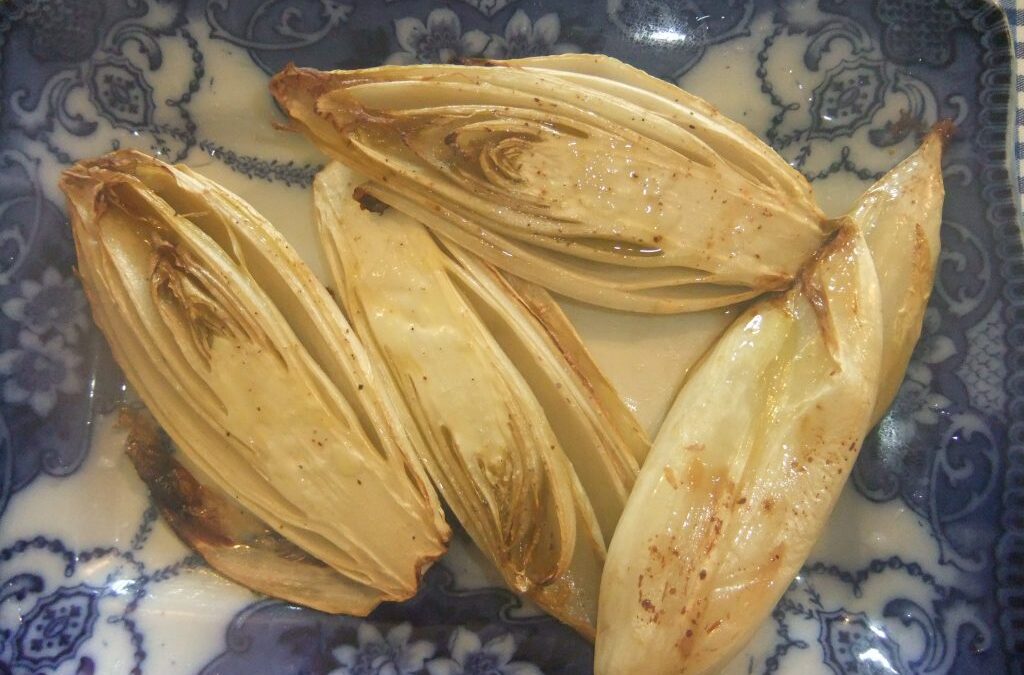
I dreamed up this easy way with chicory this evening, to go with slow roast free-range pork. We also had my braised sliced courgettes alongside, which I will post shortly. The lovely bitterness of chicory cuts the fattiness of the pork, helping you digest it. You could also serve this as a starter, with a sprinkling of parmesan, or a tablespoon of chopped, raw walnuts.
For 2:
2 medium heads of chicory, treviso, or radicchio, rinsed, then halved lengthways
Extra virgin olive oil
Freshly ground black pepper
A pinch of Atlantic sea salt or Himalayan salt
Optional: 2 DSP freshly grated parmesan cheese (avoid for dairy-free)
Preheat oven to 200C (fan 185).
Place the chicory in a roasting tin, cut side up, and drizzle over about a dessert spoon of extra virgin olive oil.
Roast for 15-20 minutes in the oven until wilted.
Serve with a few good grinds of black pepper, a pinch of salt, and another drizzle of extra virgin olive oil. If you are feeling decadent, sprinkle a teaspoon of freshly grated parmesan over each half.
Why this is good for you: Chicory, radicchio, and treviso are examples of foods that help you to digest a fatty meal. This is because their bitterness stimulates the flow of bile and digestive enzymes from your gallbladder. This helps break down (emulsify) fat into tiny droplets, which can then be digested all the easier by the digestive enzymes made in your pancreas and also in your small intestine. Other foods/drinks that do the same thing include dandelion coffee, dandelion leaves, rocket, and bitter apple sauce made from cooking apples.
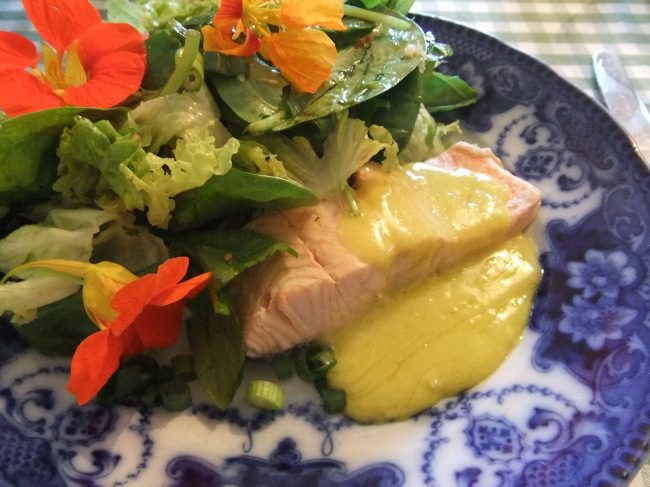
This is a traditional southern French garlic mayonnaise at its best. Always makes me think of holidays. The other day I ate a generous dollop on some poached salmon with a large salad with nasturtium flowers from the garden. Aioli is fantastic with poached or baked fish, cold meat, or hard-boiled eggs in a salad. If you like a more neutral-tasting mayo, you can use equal parts olive and a second cold-pressed (extra virgin) neutral-tasting oil such as sunflower or rapeseed. Do not use refined (non-cold-pressed) seed/nut oils as they are damaging to health. Aioli will keep for about 5 days in a glass jar in the coldest part of the fridge. The garlic helps preserve the raw eggs. It’s quicker to make aioli using an electric whisk than with the pestle and mortar. But don’t try to make it in a blender because it never thickens up for me using one!
For 4 servings:
3 cloves garlic
1 organic egg yolk, at room temperature (this helps the mixture not to “split” or separate)
150ml (approx) extra virgin olive oil (or half olive oil half raw cold-pressed sunflower or rape oil), also at room temperature
A pinch of Atlantic sea salt or Himalayan salt (optional)
You will need:
A pestle and mortar and/or an electric whisk
Pestle and mortar method:
Peel the garlic, slice into slivers, and pound to a paste with a pinch of salt, add the egg yolk, and mix in. Pounding the garlic gives a different (and in my opinion, subtler) flavour from just crushing it with a garlic crusher.
You can now either continue making the aioli with the pestle and mortar or (for less work) transfer the garlic/yolk mix to a bowl and get out your electric hand whisk before starting to add the oil as follows:
Beat in the oil, at first drop by drop, and then, as the mix begins to thicken and resemble mayonnaise, add more liberally but never in a heavy stream. It is ready when it looks thick and creamy. See below for instructions on what to do if it goes wrong.
Electric whisk method:
1. Crush the garlic (with a garlic crusher if you have one, otherwise crush with the back of a knife, using a pinch of salt to really grind up the garlic). Add to a bowl.
2. Add the egg yolk and whisk with an electric whisk for a minute.
3. Beat in the oil, at first drop by drop, and then, as the mix begins to thicken and resemble mayonnaise, add more liberally but never in a heavy stream. If you add it too quickly the mixture will split and never thicken. It is ready when it looks thick and creamy.
To rescue “split” aioli:
Get a fresh (room temperature) egg yolk and start beating it. While beating, VERY gradually and a drop at a time, start adding in the “split” mixture as if it were just oil. Very gradually incorporate the split mixture into the egg yolk, beating continuously, until you have a thick, creamy aioli.
Variations:
Add the zest of an organic lemon and 1 tbsp fresh lemon juice to room-temperature aioli (if it’s not at room temperature, adding the lemon juice will make it split). Mix well. You could also add 2 tbsp chopped parsley too.
Why this is good for you: Cold-pressed raw oils are fantastic for your health! The raw oils from sunflower, rape, and sesame are rich in polyunsaturated omega 6 oils, while extra virgin olive oil is high in monounsaturated oils and vitamin E, a powerful antioxidant. Omega 6 is fine in small amounts whereas you can enjoy unlimited extra virgin olive oil. These oils can help weight management, enhance skin health and also moisturize your skin from within. You will need to keep raw cold-pressed nut/seed oils in the fridge as they are fragile and easily go off, losing their health benefits. Refined or fried oils (all supermarket oils except extra virgin olive and cold-pressed rapeseed oil and extra virgin coconut oil) disrupt hormone balance and contribute to weight gain and visible aging. Studies have shown people lose weight when they ADD extra virgin olive oil (and raw nuts) to their diets! High-quality oils make you feel fuller longer. Never cook with polyunsaturated oils, only use them raw and cold-pressed.