This is one of my husband’s favourite desserts, as I discovered when I made it for him last weekend. This recipe is lovely and sweet but without the usual energy-sapping sugar and wheat flour. In fact its totally grain-free but you wouldn’t know it. The sponge is really good – light and moist which usually hard to achieve using grain-based gluten-free flours.
110g butter (or use clarified butter if you are sensitive to casein protein in milk or lactose in butter)
75g xylitol or erythritol
110g ground almonds
2 large beaten eggs
2 lbs cooking apples
30 drops stevia (liquid stevia available from health stores) mixed with 1 tbs water
A little extra butter/clarified butter for greasing
Oven temperature 185C (fan 170C)
Peel, core and slice the apples. Cook them in a heavy bottomed saucepan, covered with a lid, with the stevia drops and water. Stir from time to time to prevent sticking. They should still maintain their sliced shapes.
Cool thoroughly and put into a greased dish – a pyrex dish at least 18 x 18cm square works for me.
Preheat oven to 170C.
Beat the butter/clarified butter and xylitol until pale and fluffy. Slowly add beaten eggs then fold in the ground almonds and spread over the apple.
Bake for around 40 mins. The top should be golden and a skewer inserted in the sponge should come out clean. We found it was very well done after 45 minutes even though the original recipe said to bake for an hour. If it is too coloured on top but not cooked inside, then cover the top with a flat baking sheet or a bit of tinfoil (with some holes in to let steam out) to prevent it getting too brown.
Why this is better for you: The conventional apple sponge is filled with refined sugar and white flour which depletes your essential nutrients. Nutrients needed for supporting your immune system so that its neither underactive (infections) nor over-active (autoimmune conditions e.g. hypothyroidism, arthritis). Nutrients like zinc, vitamin C, B vitamins and magnesium are important for a healthy digestive system, skin and immunity. We all have different susceptibilities. In me a magnesium deficiency brought about by a refined diet might show as anxiety or insomnia. But in you it might manifest as frequent infections. Magnesium is important for hundreds of biochemical reactions in your body.
How do you increase your veggie intake to help your health if you have almost no time in the evenings to prepare a full meal or you have problems chewing? Try these green smoothies. You can even make two servings and store leftovers in an airtight glass jar in the fridge for the next day. Citrus juice and airtight containers help prevent oxidation (nutrient loss and discolouration). If you don’t like your green smoothies cold you can heat these VERY gently in a saucepan until they are lukewarm.
Garden walk (950ml or 2 servings) 1 cup baby spinach, packed
1 cup fresh parsley (any type), packed
2 large ripe tomatoes
2 tbs freshly squeezed lemon juice
½ avocado
¼ tsp chilli pepper (can cause flushing so avoid if you have rosacea)
Optional: a cupful or so of filtered, boiled and cooled, or bottled spring water to help everything go round in the blender. Wash and chop everything roughly. Blitz well.
Cucumber dill-icious soup (950ml or 2 servings)
1 large cucumber
½ a small bunch of dill (or use fresh basil if you like)
1 small avocado
3 leaves curly kale, stalks removed
1 large stalk celery
½ lime, juiced
2 cloves garlic*
Wash everything and blitz everything with a little filtered, spring or boiled and cooled water to help it all go round in the blender.
Wild green pear (makes about 500ml)
1 ripe Bartlett or Williams pear (these are lovely and sweet)
1 cup local greens (e.g. rocket, organic baby spinach, lettuce, kale, watercress, beet tops, young dandelion greens)
1 cup water
1 heaped teaspoon sunflower seeds, pumpkin seeds or 8 blanched almonds
Wash, roughly chop and blitz the fresh produce with the water and sunflower seeds.
Salad smoothie idea (or “make this up as you go along”)
Blitz a large handful of roughly chopped green leaves, a tomato, celery stick, heaped dsp chopped red onion, clove of garlic, half a red or green pepper, a glug of extra virgin olive oil, a squeeze of lemon and a generous splash of tomato juice from the carton. Add Himalayan (pink) salt and fresh ground black pepper to taste.
Green gazpacho (makes about 3 large servings)
A green take on the traditional chilled Spanish summer soup. Quite filling.
1 bunch spring onions
3 cloves garlic, roughly chopped*
1 small green pepper (stalk and seeds removed)
100g organic baby spinach ½ romaine lettuce (or any lettuce other than iceberg)
1 avocado
Small bunch fresh coriander
1 small green chilli, halved and deseeded (optional)
50g ground or blanched almonds
3 tbs extra virgin olive oil
3 tbs apple cider vinegar/1 of white wine vinegar and 2 of sherry vinegar
200ml water (filtered, boiled and cooled, or use bottled spring water)
Himalayan (pink) salt
Freshly ground black pepper to taste
Optional: 3 tbs home-made kefir or natural yoghurt (or use unsweetened soya/almond-based yoghurt if you are avoiding dairy due to sensitivity or skin health issues)*
Wash and roughly chop the veggies, leaves and herbs. Put into your blender processor with the 3 tbs olive oil, the citrus juice/vinegar, 200ml water and whizz to a thick puree. You might have to do this in 2 batches. Taste for seasoning. If it’s a bit bland then add salt, freshly ground black pepper and maybe more lemon juice/apple cider vinegar or olive oil. It’s the amount of seasonings that makes this a great soup. Serve chilled with another generous slug of extra-virgin olive oil.
For more great green smoothies buy Victoria Boutenko’s “Green Smoothie Revolution” available on www.bookdepository.com (postage is free). If you make smoothies which include a piece or two of fruit, always include some protein/good fats (e.g. nuts, seeds, avocado, coconut oil) to avoid sudden dumps of sugar in your bloodstream that compromise digestive/skin health and energy.
What’s good about green smoothies
Green veggies are rich in magnesium needed for healthy skin, a chilled mind and plenty of energy. They are giving you a range of skin-supporting, digestive-system healing and vitality boosting phytonutrients.
*Garlic is a natural antibiotic. But unlike antibiotic medications, it helps healthy bacteria in your gut to flourish and lowers levels of disease-causing yeasts and bacteria. If you are new to using raw garlic, start small and build up. As it kills off disease-causing micro-organisms you may notice some short-term flatulence! This will disappear over time as you keep going – replacing unhelpful micro-organisms in your gut with healthy ones to help every aspect of your health.
Organic vegetables and fruits, where you are eating the outer surface (rather than peeling) give you a little dose of healthy bacteria with every mouthful. In “conventional” produce good bacteria are absent. Herbicides kill the beneficial soil bacteria. Monsanto originally patented the bestselling herbicide glyphosphate as an antibiotic. It disrupts thyroid function, nerve function and is deeply toxic. Many “conventional” crops contain residues.
Why use filtered, boiled and cooled or bottled spring water in a smoothie? This is to avoid chlorine, that kills beneficial bacteria in your gut and suppresses thyroid function. Boiling allows the chlorine to evaporate. Chlorine, like fluoride, disrupts your thyroid function by blocking iodine. Iodine also helps prevent skin infections, PMS and hormonal cancers (e.g. breast, prostate).
I jumped at the chance to try this recently, and (bizarrely) it’s delicious as well as having big health benefits. Although I often use turmeric in curries and my pear breakfast smoothies I was at a loss to see where I could get it in every day. Don’t miss out the black pepper, its piperine increases the bioavailability of anti-inflammatory curcumin in turmeric by 2000%! Vary the amounts of ginger and cardamom if you want. Here I give the recipe for a latte blend as well as quantities for just one cup.
DO remember to pick milks free of emulsifiers that tear the lining of your gut – in particular carageenan (E407) , carboxymethylcellulose (E466), polysorbate 80 (E433), maltodextrin (E1400). I like Ecomil brand as it’s pretty natural.
I use dairy-free milk but if you normally drink lots of cows milk with no respiratory/sensitivity issues, use your normal…
For 1 serving (see below for quantities to make up a whole jar):
200ml/1 mug of non-dairy milk of your choice (e.g. unsweetened coconut milk, almond milk)
½ level tsp (teaspoon) turmeric powder
¼ level tsp ginger powder
¼ level tsp cardamom powder
Pinch freshly fine ground black pepper (if you leave it too coarse it just stays in bottom of the mug)
Optional: Small pinch of cayenne/chilli powder
To sweeten: a few drops of stevia or half a teaspoon of xylitol/raw honey
Heat the milk on the stove or with the electric steam milk frother on your coffee machine.
Add the spices and sweetening of your choice, whisk to mix.Variation: If you are feeling decadent, a sprinkle of Ceylon (Sri Lankan) cinnamon on top of the latte is lovely and boost vitality even more.
Turmeric latte blend (approx. 30 servings) Keep this in a glass jar with a tight-fitting lid in a dark place to keep potency and flavour.
Why this is great for you
Turmeric reduces inflammation everywhere in your digestive system. A study using 1g turmeric powder twice a day resulted in a massive improvement in remission rates in inflammatory bowel disease. 1 gram is just half a teaspoon. Turmeric is also well-studied in relieving gastritis and gastric reflux and keeping your brain healthy. What’s not to like? Ginger, like turmeric, supports your liver function to help skin, energy, bright eyes and skin. And it helps reduce nausea. Chilli powder helps thicken the mucous linings of your stomach and intestines. Chilli is used successfully in Ayurvedic medicine to heal stomach ulcers and gastritis! Its usually not the spices in “spicey food” that make people feel bad – it’s the large amounts of toxic, cheap refined oils your average Indian takeaway or restaurant uses in the cooking. Ceylon/Sri Lankan cinnamon (not “cinnamon” from supermarkets, which is in fact the cheaper cassia) has remarkable health effects. Like ginger, it can help prevent diabetes (or tackle it) but it also reduces “bad” bacteria and yeast (candida) overgrowth in your gut. Most spices have a selective effect on your gut bacteria – helping encourage growth of “good guys” and inhibiting disease-causing ones. Helpful bacteria in your gut make natural anti-bacterial and ant-viral substances like interferon gamma which travel to wherever you have an infections and help see it off.
This would be a great drink for someone with a cold or flu as it’s anti-viral and anti-inflammatory.
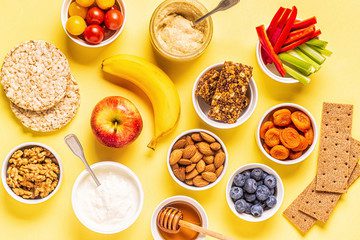
If you go for longer than 5 hours between meals you might sometimes need a snack. Most people who eat well balanced meals like on this blog don’t need to snack in-between and can fast for longer for extra health benefits. But here are some really easy snacks that give you carbohydrates (naturally sugar-containing foods like wholegrains or fruits) alongside protein/good fats (e.g. nuts, yoghurt, humous) for sustained slow-burn energy. Most of these foods are packed with nutrients to help you look and feel your best. Go for organic fruit and veg if you can – glyphosate residues on “conventional” produce kill beneficial bacteria and damage your gut. If you don’t have time for breakfast some of these snacks can fit the bill now and again if you include some fresh veg or fruit.
2 fresh apricots/plum + 4 walnut halves.
Medium pear + 8 almonds.
Medium apple + dessertspoon sunflower seeds.
Nectarine or peach + dessertspoon pumpkin seeds.
Apple + generous teaspoon almond butter straight from the jar.
Handful carrot/cucumber sticks or red pepper strips + tablespoon humous.
1-2 Nairns rough oatcakes* (available in gluten-free also) + no-sugar peanut butter.
Note: The sweet Nairn’s oatcakes/biscuits have added sugar (not a vitality-boosting snack!).
1-2 oatcakes with generous topping of humous or lots of mashed avocado.
1-2 oatcakes with thick tahini (ideally a raw brand e.g. Carly’s, from health shops).
1-2 oatcakes + cottage cheese and a sprinkle of black pepper.
Mouthful leftover cooked chicken, smoked fish + an apple, mandarin or pear afterwards.
2 fresh plums/apricots + 3 heaped tbs dairy-free “yoghurt” e.g. Coyo, Abbot Kinney’s Almond Starter, or unsweetened soya yoghurt.
Small banana blitzed with 1 cup natural yoghurt/kefir + generous pinch of turmeric or cinnamon.
For a treat try a Nakd bar from Tesco/health shops (=nuts + dried fruit).
For another treat try 1-2 squares of 80% chocolate + dessertspoon sunflower seeds or 8-10 hazelnuts. Not too often though – 80% chocolate still contains added sugar.
Now you get the idea – a great snack is a portion of slow-release carbs (e.g. oats, whole fruit, carrot sticks) + high quality protein and/or good fats
Why these snacks are better for you Carbohydrates are foods naturally high in sugars or with added sugars. Grains, root veg (potatoes, carrots) and almost all fruits are high in carbohydrates. Sugar, honey, fruit juice and white grains are even higher so aren’t a great choice in your regular diet. Carbs on their own (even from natural foods) give a quick rise in blood sugar that’s dangerous for your body. This promotes peaks and slumps in energy. But carbs combined with protein/good fats give you a better, longer-lasting slow-burn energy. Protein foods include meat, fish, beans, nuts, seeds, yoghurt, cheese, lentils and chickpeas. Great news if you want to look and feel your best for a long time to come.
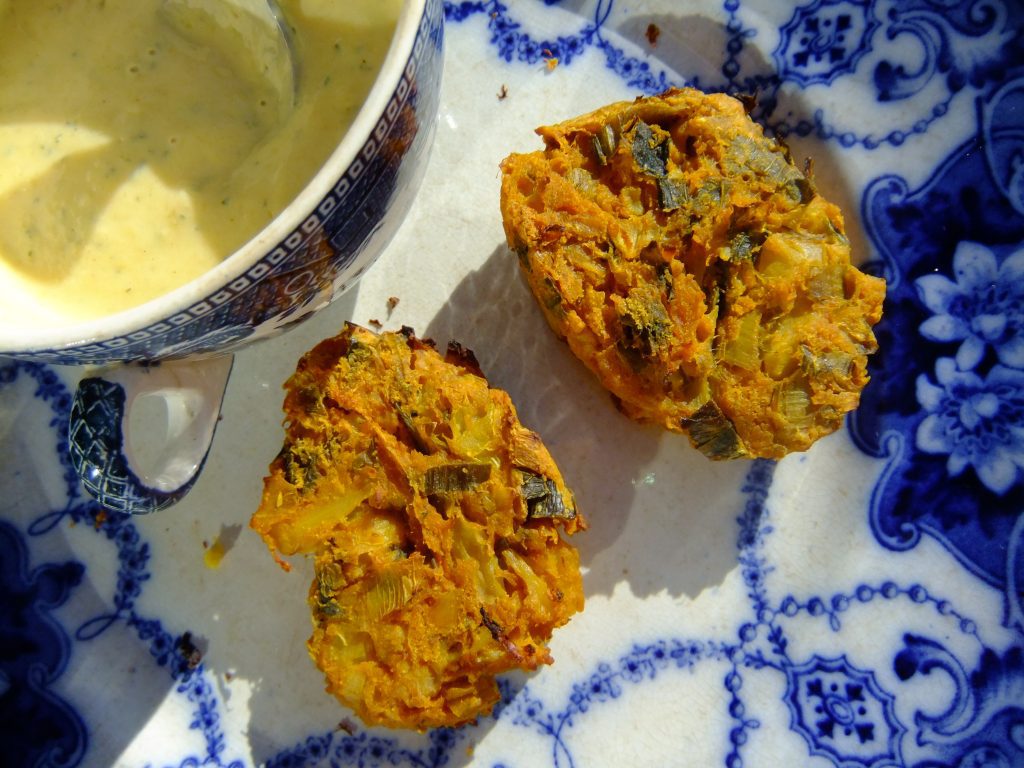
I’ve been craving bhajis that are not deep-fried and finally got my wish with this lovely oven-baked recipe. This recipe is slightly adapted from one by Susanna Booth in the Guardian. Great for a buffet, finger food for a party, as a starter, or cold for a picnic. Everyone’s happy to eat it and take seconds. They
don’t need to know that its both gluten-and dairy-free! I like these just as much cold as hot.
NB some mango chutneys contain malt vinegar, which contains gluten, so read the label carefully before you buy.
Makes 15-20
For the bhajis
300g cauliflower
2 medium leeks, green and white parts
1 tbs olive oil (or, even better, virgin coconut oil)
100 gram (chickpea) flour
1 rounded tsp (teaspoon) ground turmeric
1 level tsp ground coriander
1 level tsp ground cumin
A pinch of Himalayan or Atlantic Sea Salt
80ml water
2 tsp mango chutney (make sure it’s a gluten-free one that does not contain malt vinegar) OR 2 rounded tsp St Dalfour or Follain no added sugar apricot jam and a pinch of ground ginger OR 2 tsp unsweetened mango puree (you can do this by blitzing the mango for the dip and reserving 2 tsp for the actual bahjis).
2 rounded tsp tomato puree
Olive oil (or even better, virgin coconut oil) for greasing the baking tin
For the dip
100g natural soya yoghurt (or natural yoghurt or thickened kefir for for milk-eaters)
Half a ripe mango
1 rounded tbs (tablespoon) mango chutney (again, make sure it’s gluten-free)
5 fresh large mint leaves
1. Preheat the oven to 180C. Wash and prepare the cauliflower and leeks. Dice the cauli into tiny pieces; cut the leeks lengthways and then into thin slices. Sweat all the veg in the olive oil in a heavy bottomed pan, covered with a lid, for 5-10 minutes until just softened.
2. Put the gram flour, spices and salt in a bowl. Add the water, chutney and tomato puree and mix to a smooth paste. Add the sweated vegetables and stir until everything is well coated. It will be very thick.
3. Drizzle a little olive oil over a taking tray. Rub with a spatula or brush to coat the whole surface.
4. Dollop the bhaji mix on the tray 1 tbsp at t time. Flatten them a little with the back of a spoon, spatula or fishslice.
5. Bake for 10-15 minutes until slightly browned. Take the tray from the oven, then flip each bhaji over using a fish slice. Bake for another 10-15 minutes until golden. You can eat them hot or cold.
6. Make the dip by blitzing the chutney, mango, mint and yoghurt together in a mini food processor or else use a bowl and stick blender. Refrigerate for up to a day before serving.
Variation:
I made an imitation mango chutney for this recipe by mixing a few things I had in the cupboard: 1 1/2 tbs St. Dalfour apricot jam, a pinch of onion salt, a large pinch of each of dried garlic and ground coriander and 1/2 teaspoon of distilled or wine vinegar.
Why this is better for you: Gram (chickpea) flour is a good source of protein to help keep you feeling fuller for longer. Leeks are rich in inulin, which helps feed good gut bacteria. Good bacteria are important for all aspects of your health from weight management to clear skin and good digestion and absorption of nutrients. Because these bhajis are baked rather than deep fried which means they don’t toxic heated polyunsaturated oils. In cooking, coconut oil is even better for you then olive oil. This is because coconut oil is less damaged by heating then olive oil. coconut oil is rich in medium chain triglycerides, which can help boost energy because the body digests them very easily. Amazingly, coconut oil is used by your body directly to make energy rather then being stored as fat in your body. This makes it a better tool for weight management than many other oils. Herbs and spices such as turmeric, cumin and coriander have well-documented anti-inflammatory properties and a great health boost for anyone who cares about their health, fitness or skin.


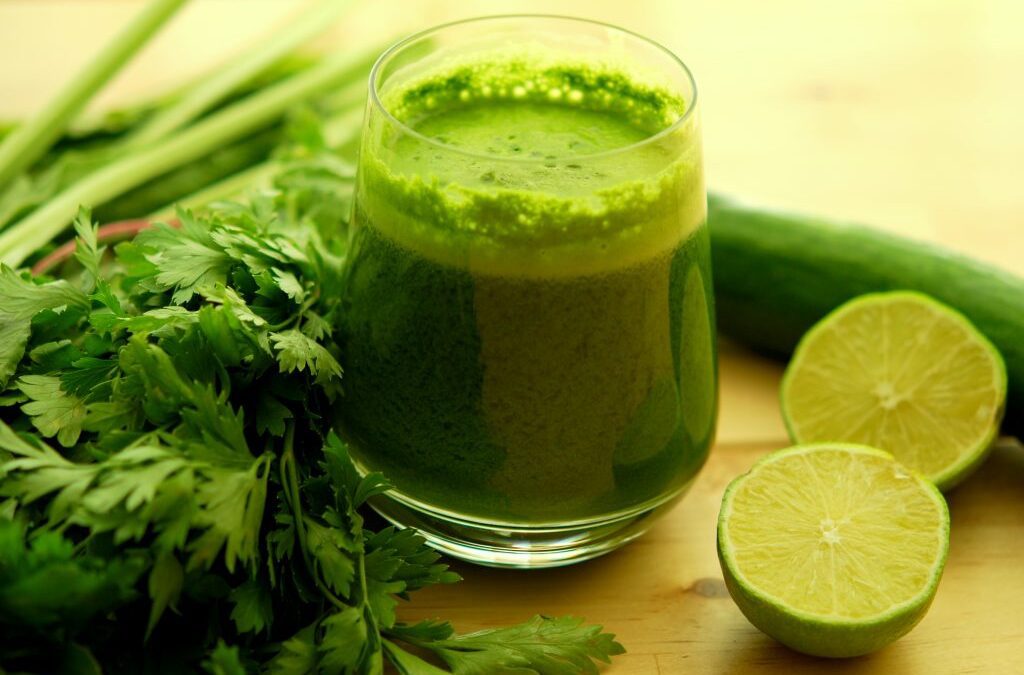
 How do you increase your veggie intake to help your health if you have almost no time in the evenings to prepare a full meal or you have problems chewing? Try these green smoothies. You can even make two servings and store leftovers in an airtight glass jar in the fridge for the next day. Citrus juice and airtight containers help prevent oxidation (nutrient loss and discolouration). If you don’t like your green smoothies cold you can heat these VERY gently in a saucepan until they are lukewarm.